Good Night, and Good Luck: AI, fear and what the job data says
- 35 minsHi all,
Some weeks ago I watched again Good Night, and Good Luck (2005), the film by George Clooney. It tells the story of Edward R. Murrow, the CBS journalist who stood up to Senator Joseph McCarthy in 1954. McCarthy did not need proof. He only needed people to be scared. Fear got attention, and attention gave him power.
While watching it, I could not stop thinking about my X.com feed. Every day I read that AI will replace software engineers in 6 months. Some of those posts come from people who are paid by engagement (blue checks). Others come from companies whose valuation grows when AI looks more powerful (and more dangerous).
So I wanted to check the data myself. Is AI really destroying software jobs? Or is something else going on?
At the end I will give my opinion. All sources are linked.
Table of contents
- What the AI reports say
- Software jobs and what the data says
- Juniors vs seniors
- Who profits from fear
- My opinion
- I am pro AI
- Conclusion
1. What the AI reports say
There are two big yearly reports about AI. Let’s see what they say about 2025 and 2026.
Stanford AI Index 2026
The AI Index 2026 was published in April 2026. These are the points I found more relevant:
- global corporate investment in AI was $581.7 billion in 2025, up 130%. The US invested $285.9B, China $12.4B
- AI agents went from 20% to 77.3% on Terminal Bench (real tasks in a terminal) in one year. But they still fail at multistep planning, financial analysis and even telling the time.
- employment among software developers aged 22-25 has fallen nearly 20% since 2024, even as older colleagues’ headcount grows. Their own words: “The disruption is targeted and just beginning.”
- only 33% of Americans expect AI to improve their jobs
State of AI Report 2026
The State of AI Report was published in October 2026:
- OpenAI and Anthropic together reached $105B in annualized revenue by late summer 2026 (from $30B at the start of the year)
- The four big US cloud companies plan around $733B of capex in 2026.
- Benchmarks are getting saturated “within months”.
- The harness matters a lot. In one study, only changing “the tools, context, and feedback” given to a model (GLM-5.1) moved it from 52.5% to 65.5% on SWE-bench Verified tasks. Same model, same weights.
- The cost to reach a fixed benchmark score falls around 13x per year. Intelligence is getting very cheap.
AI is improving fast and money is flowing like never before. But does this show in the job market?
2. Software jobs and what the data says
Indeed Hiring Lab publishes daily job postings data by country and by sector. It is an index: 100 means the same number of job postings as on 1 February 2020 (just before the pandemic). I used the data until 9 October 2026.
I compared the “Software Development” sector with all job postings, and I marked the main AI releases.
The US
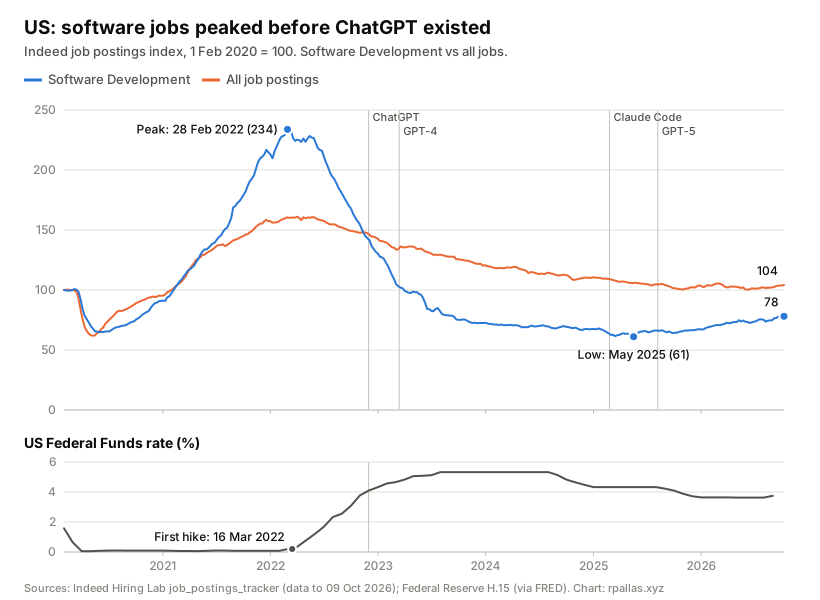
Look at the date of the peak: 28 February 2022. ChatGPT was released on 30 November 2022, nine months later.
When ChatGPT was released, software job postings in the US had already dropped 39% from the peak. More than half (53%) of the total fall happened before ChatGPT existed.
So what happened in early 2022? Look at the bottom chart. The US Federal Reserve raised interest rates for the first time on 16 March 2022, two weeks after the peak. Rates went from 0.08% to 5.33% in about a year and a half (Federal Reserve). In Europe, the ECB moved its deposit rate from -0.50% to 4.00% (ECB).
This matters a lot for software. A software project costs money today and makes money in the future. When money is free, companies hire a lot of engineers to build things that maybe will pay back in 5 years. When money costs 5%, they stop.
There are two more things to keep in mind:
- The pandemic bubble. Software postings reached 2.3x the pre pandemic level. A lot of the “collapse” is that bubble deflating. Companies overhired in 2021 and corrected in 2022 and 2023. We all know cases.
- From 2022, US companies could not deduct software developer salaries immediately as R&D, they had to spread the deduction over 5 years. This was fixed in July 2025 (Eide Bailly). However, I did not find a serious study measuring its effect on hiring.
jobs vs LLM model released
This is the index of software postings in the US on the day of each big release:
| Event | Date | Software Development | All jobs |
|---|---|---|---|
| Pre-pandemic | 2020-02-01 | 100 | 100 |
| Software peak | 2022-02-28 | 234 | 160 |
| First Fed rate hike | 2022-03-16 | 231 | 161 |
| ChatGPT | 2022-11-30 | 143 | 147 |
| GPT-4 | 2023-03-14 | 102 | 135 |
| Claude 3 | 2024-03-04 | 71 | 118 |
| o1 (reasoning models) | 2024-09-12 | 69 | 112 |
| Claude Code | 2025-02-24 | 63 | 109 |
| Software low | 2025-05-17 | 61 | 106 |
| GPT-5 | 2025-08-07 | 66 | 105 |
| Claude Opus 4.5 / Gemini 3 | 2025-11-24 | 66 | 102 |
| Latest | 2026-10-09 | 78 | 104 |
Since May 2025, software postings in the US are going up (+28%), while all job postings are flat. This is exactly the period of the best coding models and coding agents ever 🤔
Indeed found the same in their own analysis from July 2026: software postings grew almost 15% since Claude Code launched, while all postings fell 7%. They are still about 27.5% below the prepandemic level, so it is a recovery from a low point, not a boom.
It is true that job postings are not jobs. Postings measure how many new people companies want to hire. They don’t tell you how many people work in software. The US Bureau of Labor Statistics counts people working in “computer systems design and related services”. That number peaked in March 2023 (2.48 million), after ChatGPT, and it is down 5% since then (2.36 million in September 2026). It is still higher than before the pandemic (BLS). So postings fell around 70% from the peak, but the number of people working fell 5%. Companies stopped hiring much more than they fired.
Other countries
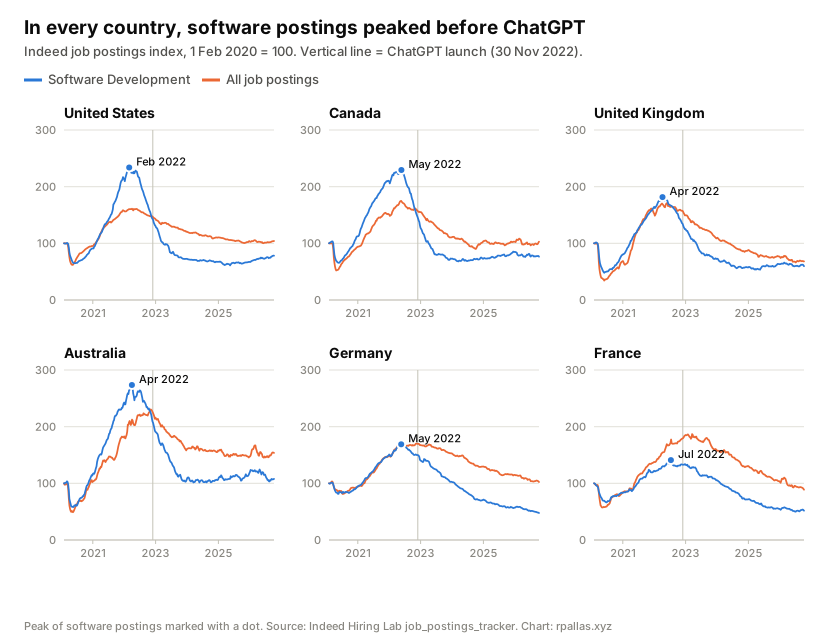
| Country | Software peak | Drop from peak to ChatGPT | Part of the total fall that happened before ChatGPT | From the low to today |
|---|---|---|---|---|
| US | Feb 2022 | -39% | 53% | +28% |
| Canada | May 2022 | -37% | 52% | +12% |
| UK | Apr 2022 | -27% | 38% | +12% |
| Australia | Apr 2022 | -24% | 38% | +7% |
| Germany | May 2022 | -11% | 16% | still at the low |
| France | Jul 2022 | -6% | 9% | +4% |
In all six countries, software postings peaked before ChatGPT.
Germany and France are different. Most of their fall came after ChatGPT, and they are still falling. Is that AI? I am not sure. All job postings are falling there too (France is at 89, below prepandemic), so it looks more like weak economies. Indeed also notes that the software share of job postings is growing in most big economies “outside Germany and France”. In Germany, software development is today the sector with the lowest index of all.
Is it only software?
No. In the US, the 5 sectors with the lowest index today are Data & Analytics, Media & Communications, IT Infrastructure, Marketing and IT Systems. Mostly white collar jobs that are exposed to AI. So I don’t think AI has zero effect. But the timing tells us the big crash was caused by economics, not by ChatGPT.
3. Juniors vs seniors
There is one place where the data really shows an AI effect young people.
Erik Brynjolfsson and his team at Stanford use payroll data from ADP (millions of US workers). Their paper Canaries in the Coal Mine, updated in August 2026, finds:
- No economy wide job loss.
- But workers aged 22–25 in AI-exposed jobs are 19% below where they would be if they had grown like less exposed jobs.
- Experienced workers don’t show this gap.
- The effect comes from less hiring of young people, not from more firing.
What about interest rates? They checked it in a separate note (February 2026). AI exposed jobs are, on average, less sensitive to interest rates, so rates don’t explain this specific gap well. But they also say that the fall for young software developers “is a consequence of various factors”, and that the AI part only becomes clear in 2024.
The Indeed recovery confirms the same pattern from the other side: 71% of the growth in software postings (May 2025 to May 2026) came from senior roles, and 37% from job titles that include “AI”.
So in summary:
Economics explains the crash. AI explains the shape of the recovery: fewer juniors, more seniors.
And there is one more number I find important. Fewer people are studying computer science. In the US, undergraduate enrollment in computer and information science at 4 year colleges fell 8.1% in fall 2025, while total enrollment grew (National Student Clearinghouse).
4. Who profits from fear
Social media
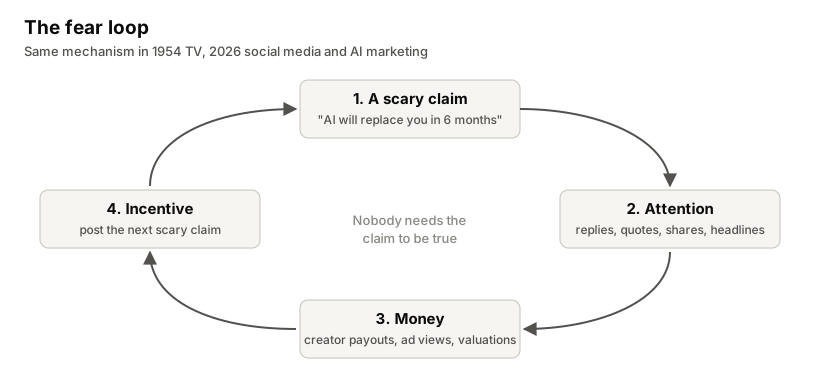
X.com changed its creator program some time ago. Payouts now depend on how much Premium (blue check) users engage with your posts (MediaPost). The post does not need to be true. It needs replies, quotes and shares. And nothing gets more replies than “you will lose your job”.
This is a perverse incentive.
AI companies
Some quotes from the people who sell AI:
- Jensen Huang (NVIDIA), February 2024: “It is our job to create computing technology such that nobody has to program” (Computing).
- Dario Amodei (Anthropic), May 2025: AI could eliminate half of all entry-level white-collar jobs and push unemployment to 10–20% in 1 to 5 years (Axios).
And the valuations:
- Anthropic raised $65B at a $965B valuation in May 2026, from $380B in February (Bloomberg Law), more than OpenAI.
- NVIDIA is “marching toward a $6T market cap” (State of AI).
And it works. Pew Research asked the same question to AI experts and to normal people: will AI have a positive impact on how people do their jobs in the next 20 years? 73% of the experts said yes. Only 23% of the US public said yes (Pew Research, 2025). A 50 point gap between the people who build the technology and the people who read the headlines…
Now, I don’t think all these warnings are lies. Amodei says he talks about it so governments can prepare, and maybe he really believes it. But the incentives point in the same direction: the scarier the AI, the more valuable the company that owns it. When a claim is also a sales pitch, we should check the data.
Fear also moves markets. In February 2026, after Anthropic released plugins for Claude Cowork, around $285B was wiped from software stocks in two weeks. People called it the “SaaSpocalypse”. Then there was a sharp rebound later in the year (State of AI).
What Anthropic says vs. what Anthropic does
In January 2026, at Davos, Dario Amodei said that AI models could do “most, maybe all” of what software engineers do in 6 to 12 months. He also said: “I have engineers within Anthropic who say I don’t write any code anymore. I just let the model write the code, I edit it.” (Entrepreneur)
Nine months later, did the job disappear? Let’s look at what Anthropic does, not what it says. I counted the open roles on Anthropic’s own job board, month by month, using old snapshots from the Internet Archive:
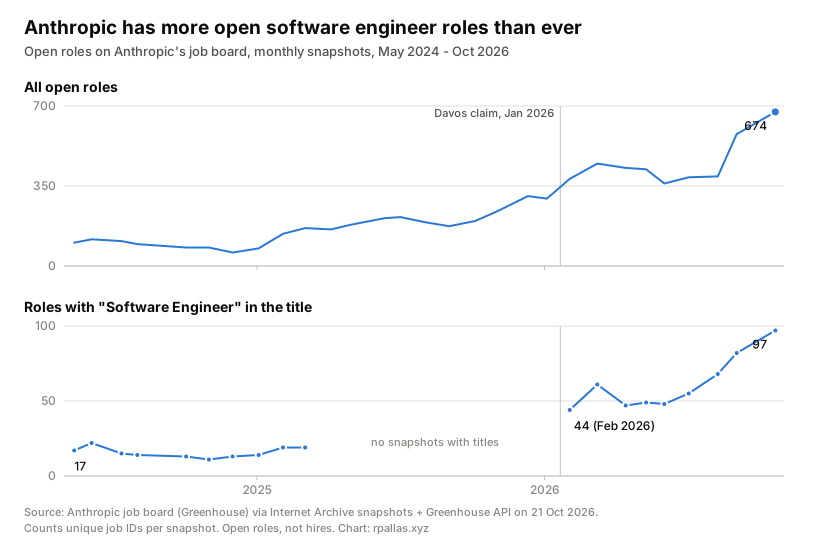
- In February 2026, just after Davos, Anthropic had 44 open roles with “Software Engineer” in the title. On 21 October 2026 it has 97. More than double.
- In May 2024 it had 17.
- In total, Anthropic has 674 open roles today, from 102 in May 2024 (Anthropic job board, data).
Of course, open roles are not hires, and Anthropic is growing very fast (its revenue grew a lot in 2026), so it hires for everything. Also, the 12 months are not over until January 2027. I will check again.
But look at Amodei’s own quote again. His engineers still work at Anthropic. They just don’t type the code anymore, they direct the model and edit what it writes. The job changed. It didn’t disappear. And the company that knows these models better than anyone is looking for more software engineers than ever.
Why AI companies need the fear
There is another reason why “AI is incredibly powerful” is a useful message for AI companies. It has to do with your own computer.
The hardware you need to run a good model gets smaller every year:
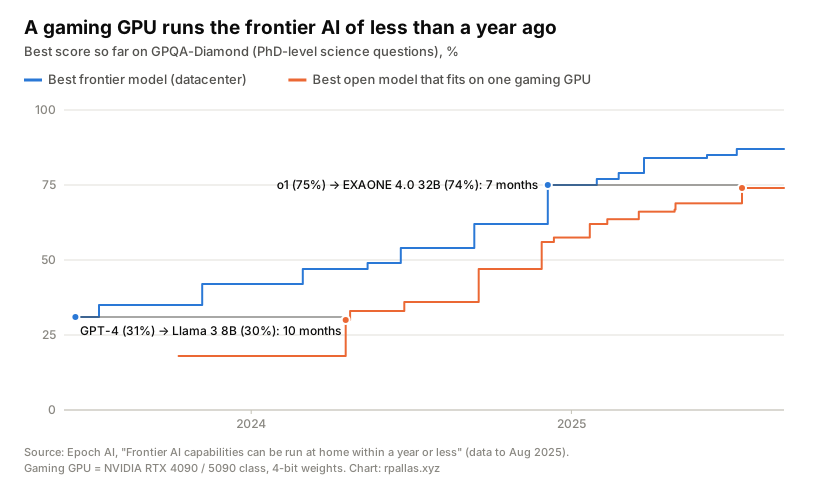
- Open models that fit on one gaming GPU (an RTX 4090 or 5090, less than $2,500) match the best frontier models from 6 to 12 months earlier (Epoch AI). GPT-4 needed a datacenter in 2023. Ten months later, Llama 3 8B got about the same score (30% vs 31%) on a gaming PC.
- If we look at all open models (not only the ones that fit on one GPU), they are now only 4 months behind the best closed models (Epoch AI, May 2026).
- In 2022, the smallest model scoring above 60% on a common knowledge test (MMLU) had 540 billion parameters. In 2024, a model with 3.8 billion did the same: 142 times smaller, small enough for a phone. And the price of a GPT-3.5 level answer fell 280 times in less than two years (Stanford AI Index 2025).
So think about the business of OpenAI, Anthropic and friends. If a free model running on your laptop is good enough for most of your tasks, why would you pay a subscription? Their business only works if they stay far ahead of what you can run at home. And staying ahead costs a lot: remember the $733B of capex in 2026.
Markets know this. In January 2025, DeepSeek released a cheap open model, and Nvidia lost almost $600 billion of market value in a single day, the biggest one-day drop for any company in US history (CNBC). It recovered in a few weeks, but the fear was clear: “good enough and cheap” is a threat.
This is where the fear helps. “AI is so powerful that it will replace all of you” also means “you need the most powerful model, and only we have it”. It justifies the valuations and the billions in datacenters needed to stay ahead.
That said, the frontier keeps moving too, and some things (agents working for hours, very long documents) still need datacenters. “Good enough” depends on the task. But for many tasks, the model on your laptop is already enough, and every year it is enough for more tasks.
5. My opinion
From here, this is my opinion. You can disagree, of course.
“AI can clone any SaaS”
Lot of people say this on X. And it is true. But it was already true before. Any good developer could build a clone of Slack or Notion. There are lots of open source clones of almost every popular product, and they have existed for years.
What changed is the cost. Before, a clone took months. Now it takes days (or less). That is a big change, but the moat of a SaaS company was never the code. It was distribution, data, integrations, compliance, support, maintenance and trust. Customers don’t move their whole company to a new tool only because it is cheaper to build.
Anyone can build a subscription checkout screen in 20 minutes with AI. Now handle payments from Apple, Google and Stripe, refunds, webhooks that arrive twice or out of order, taxes in every country, and an accounting ledger that must always match. That is where the years of work are. And code is not an asset, code is a liability: every line you ship, you have to maintain.
Good news for current seniors?
I keep thnking about this every week. If everybody repeats that software engineers will be replaced:
- fewer young people study computer science (-8.1% already).
- Companies hire fewer juniors (-19% gap).
- Some engineers leave the profession.
Fewer people with real experience. And companies are hiring seniors again (71% of the recovery). It reminds me of house prices: when no new houses are built, the people who already own a house win.
About “don’t bet your career on software”
I read this post on X by Yingjun Wu, founder of RisingWave (a streaming database):
“I honestly don’t think engineers should bet their careers on simply mastering software development - whether it’s databases, search engine, inference engines, or anything else. AI will eventually automate much of this engineering work.
The real moat lies elsewhere: communicating with customers, understanding their pain points, identifying problems worth solving, and winning humans’ trust.”
I agree with half of it. Understanding the customer and finding problems worth solving was always the most important skill. Code was always a tool, not the goal (before AI and now).
But I disagree with the other half. Databases, search engines and inference engines are exactly where deep knowledge matters more with AI, not less. AI writes a lot of code, but someone has to know if that code is correct, fast and safe. The State of AI report warns that benchmark scores can overstate finished work. Deep expertise is what lets you verify the machine.
I don’t think it is one or the other. The best engineers I know do both: they go very deep on technology and they explain it well to people.
Andrew Ng said it well: discouraging people from learning to code “will be seen as some of the worst career advice ever given.”
The limits of current LLMs
I use AI every day to code, and it is very useful. The software engineering job has already changed a lot. The way I work today has nothing to do with how I worked two years ago. If you think nothing has changed, you probably haven’t tried the latest models and tools seriously. Nobody who has used them can deny it.
So, as engineers, we should adapt. We should not be “code romantics”, in love with writing every line by hand. We should just be engineers: use the best tools we have to solve the problem. That is what engineers have always done.
But I don’t think the current LLM architecture will replace human work. (but other architectures will do, for sure…)
Some authors think something similar:
- Yann LeCun left Meta and founded AMI Labs to build “world models”, a different architecture, because he thinks LLMs will not reach human-level intelligence (MIT Technology Review).
- Ilya Sutskever (co-founder of OpenAI), November 2025: “from 2020 to 2025, it was the age of scaling”, and now “it’s back to the age of research again, just with big computers”. Also: “These models somehow just generalize dramatically worse than people.” (Dwarkesh Podcast)
Why is there a limit?
An LLM is trained to do one thing: predict the next word. It read a huge part of the internet and learned which word usually comes next. That simple idea is surprisingly powerful. But it also has some limits:
- It learned from text, not from the world. A child learns that a glass breaks when it falls by seeing it happen. An LLM only read descriptions of glasses falling. LeCun says LLMs are “limited to the discrete world of text” and “can’t predict the consequences of their actions” (MIT Technology Review).
- It needs millions of examples to learn what we learn with a few. A junior engineer sees a pattern two or three times and gets it. The model needed to see it millions of times during training. That is what Sutskever means when he says they “generalize dramatically worse than people”.
- It doesn’t keep learning after training. Once trained, the model is frozen. A junior engineer gets better every week at your company. The model only gets better when a new version is released. Karpathy: “They don’t have continual learning. You can’t just tell them something and they’ll remember it.” (Simon Willison’s notes)
- It prefers to guess than to say “I don’t know”. OpenAI researchers explain that models hallucinate “because the training and evaluation procedures reward guessing” (arXiv). It is like a multiple choice exam where wrong answers don’t subtract points: you always guess.
- It can break when the problem is harder than what it has seen. Apple researchers found that reasoning models suffer a “complete accuracy collapse” when puzzles become complex enough (Apple). Other researchers argue that part of it was the test setup, but the debate shows the limits are real.
- We are running out of human text. The recipe until now was simple: more data and more computers. But Epoch AI estimates that models will use all the good quality public text written by humans somewhere between 2026 and 2032 (Epoch AI). This is why Sutskever says we are back to the “age of research”.
So, to replace human work, we need something that understands the physical world, learns from a few examples, keeps learning every day and knows when it doesn’t know. Current LLMs don’t do any of these well yet. That is why researchers like LeCun are looking for new architectures.
The data shows that models still improve (Terminal Bench from 20% to 77%). But a lot of the recent progress comes from better tools and harnesses around the model (the 52.5% -> 65.5% example), and benchmarks get saturated much faster than real work gets reliable…
I think this also explains why AI works so well for coding in particular. The model proposes a change, and then the type checker, the compiler and the tests tell it if it is wrong. It tries again until everything passes. Software engineers spent 50 years building these tools that verify our work.
Also, our feelings are not good measures. In the METR study (2025), 16 experienced open source developers were 19% slower with AI tools, but they believed they were 20% faster. METR says these results are now old and tools are better. But the lesson is still valid: measure, don’t guess.
What history says about automation and jobs
Every big technology came with the same fear: machines will take our jobs. Tractors, factories, computers, the internet. And every time, in the end, there were more jobs, not fewer.
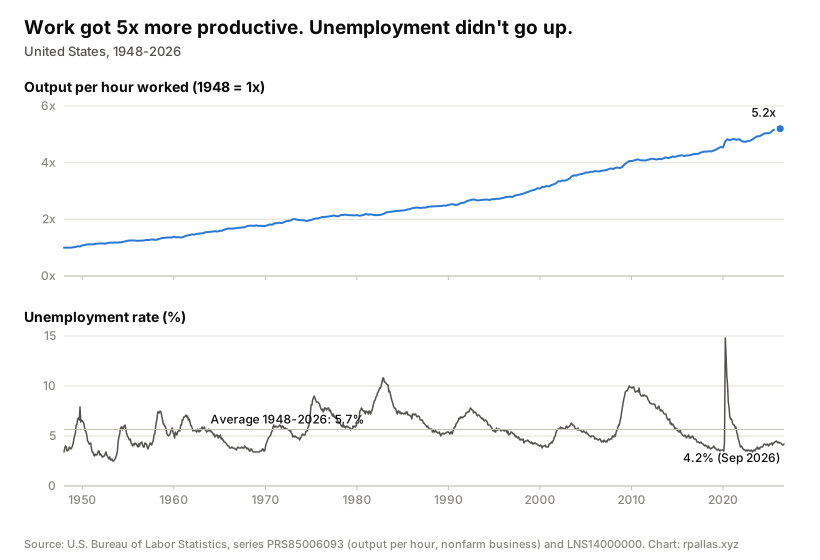
Since 1948, one hour of work in the US produces 5.2 times more (BLS). Machines, computers and software did a lot of the work that people did before. If automation destroyed jobs in total, unemployment should have gone up over these 78 years. It didn’t. It goes up and down with recessions, but it has no upward trend: 4.5% on average in the 1950s, 4.8% in the 2020s, and 4.2% in September 2026 (BLS).
The jobs just changed. David Autor (MIT) and his colleagues studied this and found that the majority of jobs in the US today are in job types that did not exist in 1940 (NBER). In 1940 nobody was a software engineer.
But the same paper also finds that in the last 40 years automation is destroying old work faster than it creates new work. So history is a good sign, not a guarantee…
Automated economies don’t have more unemployment. They have better jobs
If automation caused unemployment, the most automated economies would have the most unemployed people. This is what the data shows, grouping countries by income (World Bank):
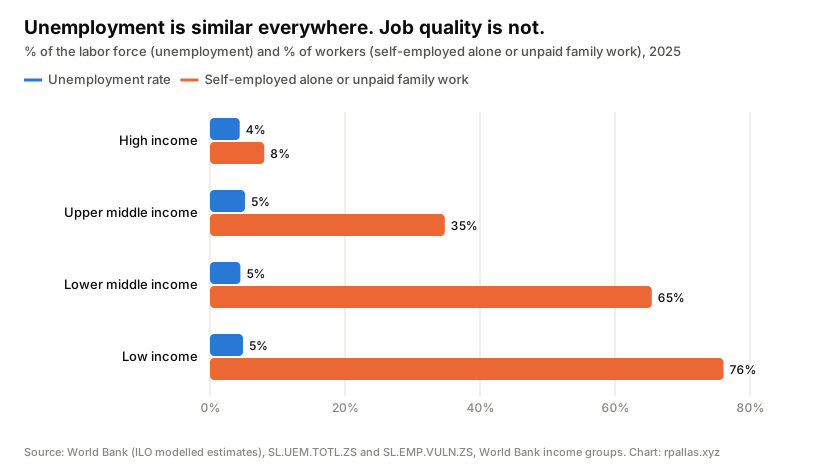
Unemployment is almost the same everywhere: around 4-5%. What changes is the type of job. In high-income countries, 8% of workers are self-employed alone or work unpaid in a family business. In low-income countries it is 76% (World Bank). Those jobs usually have no contract, no stable income and no protection.
I want to be careful here: this is not about effort. People in lower-income countries often work more hours, in harder conditions. The difference is the tools, the machines and the capital that each worker has. And it is changing: worldwide, the share of these jobs went down from 49% in 1991 to 42% in 2025, and in East Asia from 52% to 35%.
The same with robots. The countries with the most robots per worker are South Korea (1,220 per 10,000 factory workers), Singapore (818), Germany (449) and Japan (446) (IFR). All four have unemployment below 4%.
This does not mean that robots never hurt anybody. In the US, areas with more robots lost jobs and wages (Acemoglu and Restrepo). In Germany, robots destroyed factory jobs, but new service jobs replaced them (Dauth et al.). The transition is hard for some people. But in total, automation didn’t take the work. It made the work better paid.
So far, every time, new jobs appeared. But what happens if one day machines can do every job, including the new ones? Then history can’t help us, and we need to ask a different question…
Who owns the machines?
I think that, eventually, human labor will mostly disappear. And I think that is good. But not with the current LLMs, and not in 6 months.
When that happens, things will be very cheap. We already see it: the cost of the same AI capability falls 13x per year. But if people cannot sell their work, how do they earn money to buy even cheap things? And how do they build capital?
This is already happening slowly. This is the share of US income that goes to workers (the rest goes to capital):
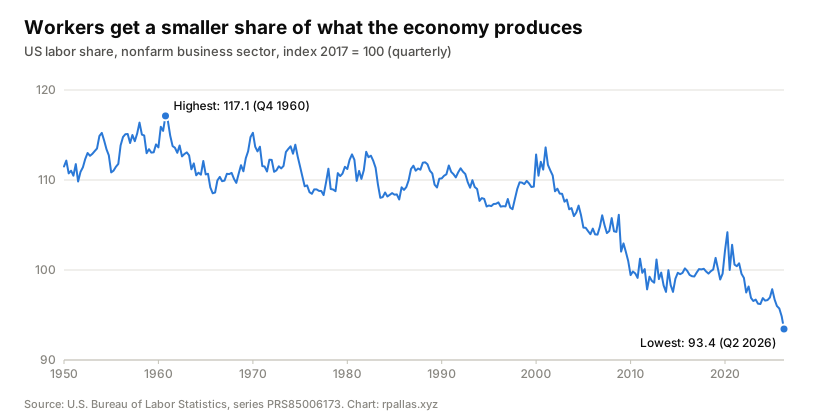
In the second quarter of 2026 it reached 93.4, the lowest value since the data started in 1947 (BLS). It started falling long before AI, so it is not caused by AI. But AI can make it go much faster.
The common answer is Universal Basic Income. There is some real data. The OpenResearch study (funded by Sam Altman) gave 1,000 people $1,000 per month for 3 years. They worked around 1.3–1.4 hours less per week than the control group. Not a disaster, but it doesn’t solve the main problem either. It gives people income, not ownership.
Juan Ramón Rallo wrote a whole book against it: Contra la renta básica (Deusto, 2015). His main argument is ethical, not economic: forcing some people to pay for the life projects of others is unfair and limits our freedom.
I find his argument strong for today’s world. But there is something that worries me about the future.
The person born in 2075
Today, anyone can follow these steps:
- You are born with no capital, so you sell your work.
- You spend less than you earn, and save.
- You invest those savings (shares, a house, your own company). Slowly, you become an owner of capital.
Work is the first step to own capital. Now imagine someone born in 2075, when machines do any job cheaper than a human. Things are very cheap, but this person has no capital and nobody will pay for their work. How do they take the first step? If there is no way, capital will stay forever in the hands of the people who owned the machines on the day human work stopped being needed.
The liberal answer needs a first step
Rallo has a liberal answer to robots, and it is not taxing them. In 2019 he proposed moving towards a “society of owners”: people save part of their income and invest it in the companies that automate (as shareholders, or through private pension funds). Then the robots pay us, because we own them. His words: “En lugar de erradicar fiscalmente a los robots, convirtámonos en sus dueños”, instead of taxing the robots out of existence, let’s become their owners (El Confidencial).
This might work today. But look at the steps again. Rallo’s solution starts at step 2: save part of your income. The person born in 2075 is stuck at step 1. They have no income to save.
What if someone owns all the water?
Liberalism has an old rule for this, from John Locke (1689): you can own something only if you leave “enough, and as good” for the others. This is called the Lockean proviso (Wikipedia).
Robert Nozick, the most famous libertarian philosopher, gave it a modern version in Anarchy, State, and Utopia (1974): owning something is fine, as long as the others are not worse off than if nobody owned it. His example: if you own the only water hole left in the desert, you cannot charge whatever you want for the water.
Rallo agrees. He calls Nozick’s version “sensata y compatible con el desarrollo de un orden liberal” (sensible and compatible with a liberal order), and he asks the hard question himself: “imaginemos un individuo que monopoliza, por apropiación originaria, toda el agua del planeta Tierra. ¿Sería un derecho de propiedad legítimo?” Imagine one person who owns all the water on Earth. Would that be legitimate? He also writes that using property, even without violence, in a way that “severely removes other people’s ability to act” can be seen as illegitimate (Rallo, 2017).
Now let’s apply this to the machines. In 2075, the machines are the water. Everything you need to live is produced by machines. And machines need land, energy and minerals, which nobody created. If a few people own all of it, and nobody will pay for your work, you are in the desert and someone owns every water hole.
If we apply the rules that Nozick and Rallo themselves accept, that property system would not be legitimate for that person. Something is owed to them, a compensation.
And I think the best form of compensation is not a monthly check forever. It is the first step: a share of the machines. Thomas Paine proposed exactly this in 1797, in Agrarian Justice. Because “the earth, in its natural uncultivated state… was the common property of the human race”, landowners should pay into a fund that gives every person £15 at age 21 to start their life (Wikipedia). For Paine, it was the payment that owners make for the right to hold private property. Today we already see small versions of this idea: since July 2026, every baby born in the US from 2025 to 2028 gets $1,000 invested in an S&P 500 index fund (Scripps News), and in October 2026 Anthropic committed 5% of its shares to a public benefit fund (TechCrunch).
So we still need a (minimal) state
But there is a problem. If the owners of the machines refuse to pay that compensation, who makes them pay? Someone with the monopoly of force. A state.
This hurts any anarchist utopia. As long as there can be violence and injustice, someone needs to protect rights and make sure the compensation happens. Nozick reached the same conclusion: the first part of Anarchy, State, and Utopia was written to answer the anarchists, and to show that a minimal, “nightwatchman” state can be justified (Stanford Encyclopedia of Philosophy). His theory of justice has three parts: how you acquire things, how you transfer them, and how you rectify injustice.
So my conclusion: we need a state, but an minimal one. One that protects rights and makes sure nobody owns all the water. Not a state that owns the machines, and not a state that decides how everybody should live.
I don’t have the full answer. But I know which world I prefer: one where everybody owns a part of the machines, not one where the state owns them, or only a few do.
6. I am pro AI
After reading all this, you may think I am against AI. I am not. I am very pro AI.
As I said, I think that eventually AI will replace all human labor, and I think that is a good thing. But with current LLMs, I still think code is important.
Here I agree with Grady Booch. He says the entire history of software engineering is one of rising levels of abstraction (IEEE Spectrum): from machine code to assembly, to high-level languages, to frameworks and cloud platforms. In February 2026 he compared AI coding assistants to what happened when compilers appeared, and said: “Fear not, developers. Your tools are changing, but your problems are not.” (The Pragmatic Engineer). Programmers were also afraid of compilers, and the profession grew.
For now, an LLM is another layer of abstraction. A very powerful one, because we can describe what we want in English. But someone still needs to understand what happens in the layers below.
Let me tell you how I work today. I haven’t written a single line of code by hand in 2026. But I read and review a lot of code. I use LLMs to build better software, and faster than ever. And in the end, we own the code we ship, even if an LLM wrote it. If it breaks in production, nobody will ask which model wrote it. That doesn’t change.
Even this article: I used AI to write it, rewrite it, rewrite it again, and again, for days. But the opinions are mine, I told the LLM what ideas and reasonings to write, I checked the data, and I am the one publishing it. Same as with code: I own what I ship. The difference is that it took me days instead of weeks writing this article.
So, as engineers, we need to embrace the change and adapt, like we always did with new languages, frameworks and tools. And remember what our job really is. The important thing in our job is not the code. It is our customers: to help them and make their lives easier. Code was always just the way to do it.
What I think AI is already replacing is not developers. It is bloated engineering organizations with thousands of engineers. Fred Brooks explained in The Mythical Man-Month (1975) that every person you add to a team adds more communication paths: a team of n people has n(n-1)/2 of them. A team of 5 has 10. A team of 50 has 1,225. Big organizations spend a lot of their time just coordinating.
Those organizations are being replaced by small, autonomous teams of engineers powered by AI tools, that can ship value very fast. Some jobs will disappear, mostly some junior roles, and people who never really liked software and joined the industry after a quick bootcamp only for the salary. But engineers who love building things and care about their customers will be as valuable as before.
7. Conclusion
In 1958, Murrow gave a famous speech to the radio and TV news directors. He said that television can teach and inspire, but only if people decide to use it for that. Otherwise, “it is nothing but wires and lights in a box” (Poynter).
AI is the same. It is a powerful tool. It can make us much richer, or it can be one more machine to produce fear and engagement.
What the data says:
- Software job postings crashed in 2022 because of interest rates and the end of the pandemic bubble, not because of ChatGPT.
- Job postings are not jobs. In the US, software postings fell around 70% from the peak, but the number of people working in software fell only 5% from its 2023 peak, and it is still above pre-pandemic.
- Since May 2025, with the best coding agents, US software postings are growing again. Even Anthropic, after saying AI could do most of the job in 6 to 12 months, more than doubled its open software engineer roles (44 to 97).
- AI is hurting juniors, and helping (for now) experienced engineers.
- A gaming GPU runs the frontier AI of less than a year ago. AI companies need you to believe that only their models are enough.
- In 78 years, work became 5.2 times more productive, and unemployment didn’t go up.
What I think:
- Current LLMs are a new layer of abstraction, not a replacement. The job changed, and we still own what we ship.
- The long term problem is not “learn to code or not”. It is who owns the machines when human work is not needed anymore. If a few people own all the water, even Nozick’s rules say something is owed to the rest. I prefer a world where everybody owns a part of the machines, with a state as minimal as possible to make sure of it.
Like television for Murrow, AI doesn’t decide what it will be used for, or who will own it. We do.
So next time you read “AI will replace you in 6 months”, check who is posting it and what they earn from it.
Good night, and good luck.
Thanks for reading!
Ricardo.
PS: I didn’t talk about the AI alignment problem (how to make sure that AI systems do what we really want, and stay safe as they get more powerful). It is a very important topic, but I didn’t want to make this post even longer. Maybe in a future post.

Ricardo Pallas
λ Software Engineer